Where online could save time in-store: research with 1,500+ GCC shoppers

Landmark Group –
Overview
At Landmark Group, we explored how online services could make shopping in-store easier. Customers could research a product online and still struggle to find it in a store, or try it in person only to face a long checkout queue.
A survey with more than 1,500 responses and moderated interviews pointed to a useful pattern: stores helped shoppers judge a product; online services helped them save time. We mapped those experiences and tested four concepts, exploring ways to check stock before a visit, continue a purchase online, and reduce time at checkout.
- Of customers shopped offline only
- 88%
- Named uncertainty about fit as their biggest online challenge
- 66%
- Named long payment queues as their biggest in-store pain point
- 41%
- Shopped online mainly because it was quick and easy
- 80%
The project covered customer research, journey synthesis, and concept testing. I worked on it with Diksha, our lead product designer, and Adeorike, a UX researcher.
The challenge
Most of our customer base shopped offline only. Yet when we asked survey participants which channel they preferred, nearly half chose both. That gap suggested room to bring the two together.
- Offline only
- 88%
- Online only
- 3%
- Both channels
- 9%
- In-store
- 24%
- Online
- 29%
- Both
- 47%
The central question was where an online service could remove uncertainty or save time during a store visit. To answer it, we needed to understand why customers chose each channel and where their shopping experience broke down.
Research and findings
We used the survey to understand shopping patterns, and to shape the goals and discussion guide for the interviews.
- Survey
- 1,500+ responses across the UAE, Saudi Arabia, Qatar, Kuwait, Bahrain, and Oman
- Interviews
- 6 moderated sessions of 50–60 minutes, in English, remote and in person, in Saudi Arabia, Bahrain, and the UAE
- Journey mapping
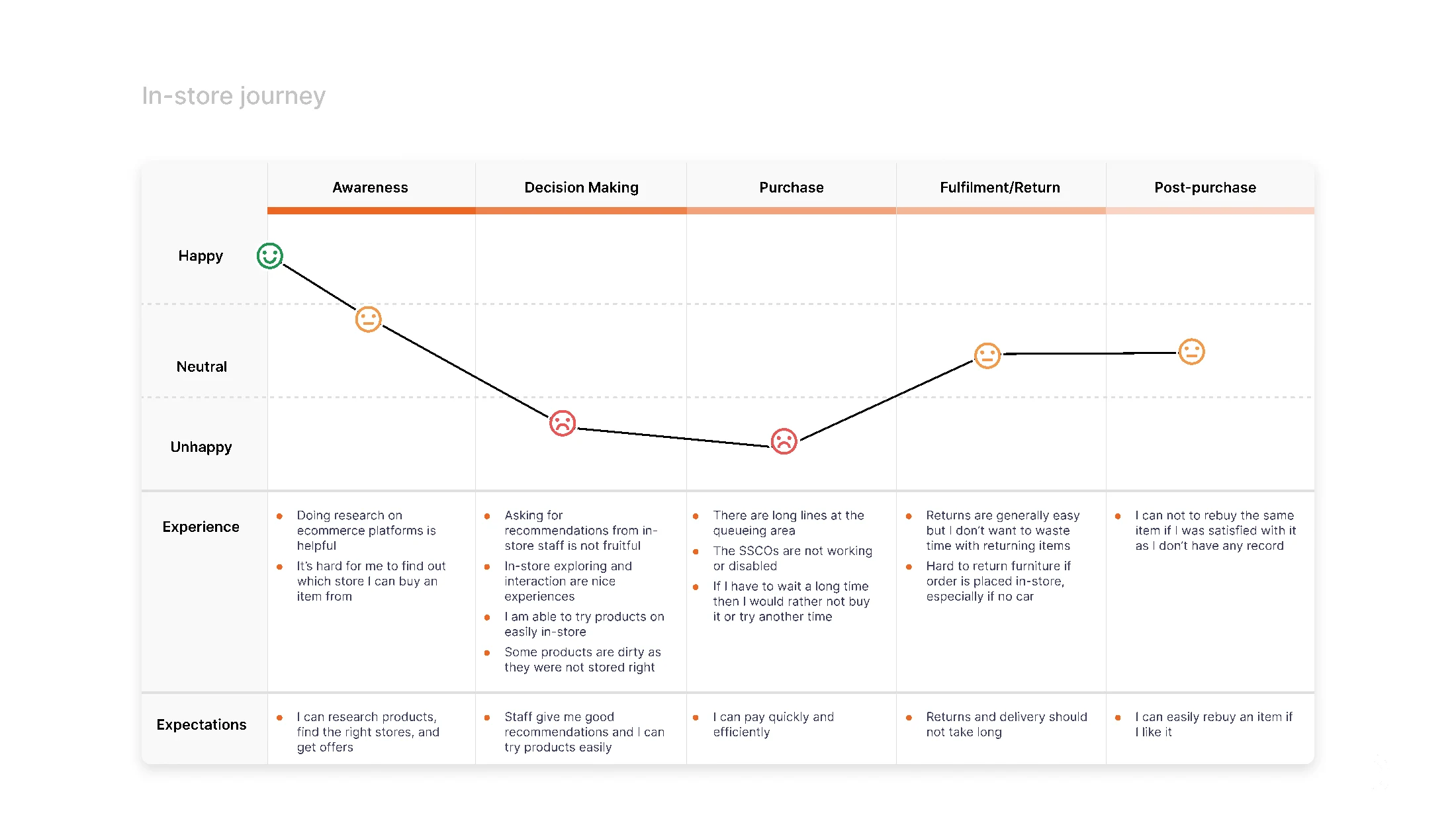
- Online and in-store, across five stages: awareness, decision-making, purchase, fulfilment and returns, and post-purchase
The interview group was small, mostly men and customers in lower loyalty tiers, so we used those conversations to understand individual experiences and read them alongside the broader survey.
Four needs stood out, in the order they come up during a shopping trip:
Reliable stock information
Several interview participants struggled to find where an item was available, leading to extra travel, multiple store visits, or an abandoned shopping session.
Opportunity · Show which store has the right item, size, and colour before a customer travels.
Confidence before committing
66% of survey participants named uncertainty about fit as their biggest online challenge. Stores let shoppers inspect quality, feel materials, and try sizes, and some interview participants already researched online before visiting.
Opportunity · Connect online research with inspecting the item in person.
A faster way to finish
41% named long payment queues as their biggest in-store pain point, and 80% chose “quick and easy” as their main reason to shop online. Interview participants also described unavailable or broken self-service checkouts.
Opportunity · Make paying quick, and dependable enough for shoppers to rely on.
Convenience after purchase
Returns were generally manageable but time-consuming. Some furniture returns required another store visit, and some participants chose click and collect when delivery felt slower.
Opportunity · Carry convenience through to collection and returns.
Seeing the journey end to end showed how these frustrations add up: a customer could struggle to locate stock before a visit, feel uncertain about a product, and then face another delay at checkout.
From findings to concepts
Those who did mainly compared prices or showed staff pictures of products. To earn a place in that experience, the app needed to help with something shoppers were already trying to do. So we turned each need into a concept:
- What shoppers needed: Reliable stock informationConcept we tested: In-store availability
- What shoppers needed: Confidence before committingConcept we tested: Product barcode scanner
- What shoppers needed: A faster way to finishConcept we tested: Scan and go
- What shoppers needed: Convenience after purchaseConcept we tested: Digital receipts
We tested the four concepts with participants to understand their appeal and what each would need in order to work. The feedback raised changes to the interface, and what each concept would need from the business behind it: accurate stock, checkouts that work, and purchase records customers trust.
In-store availability
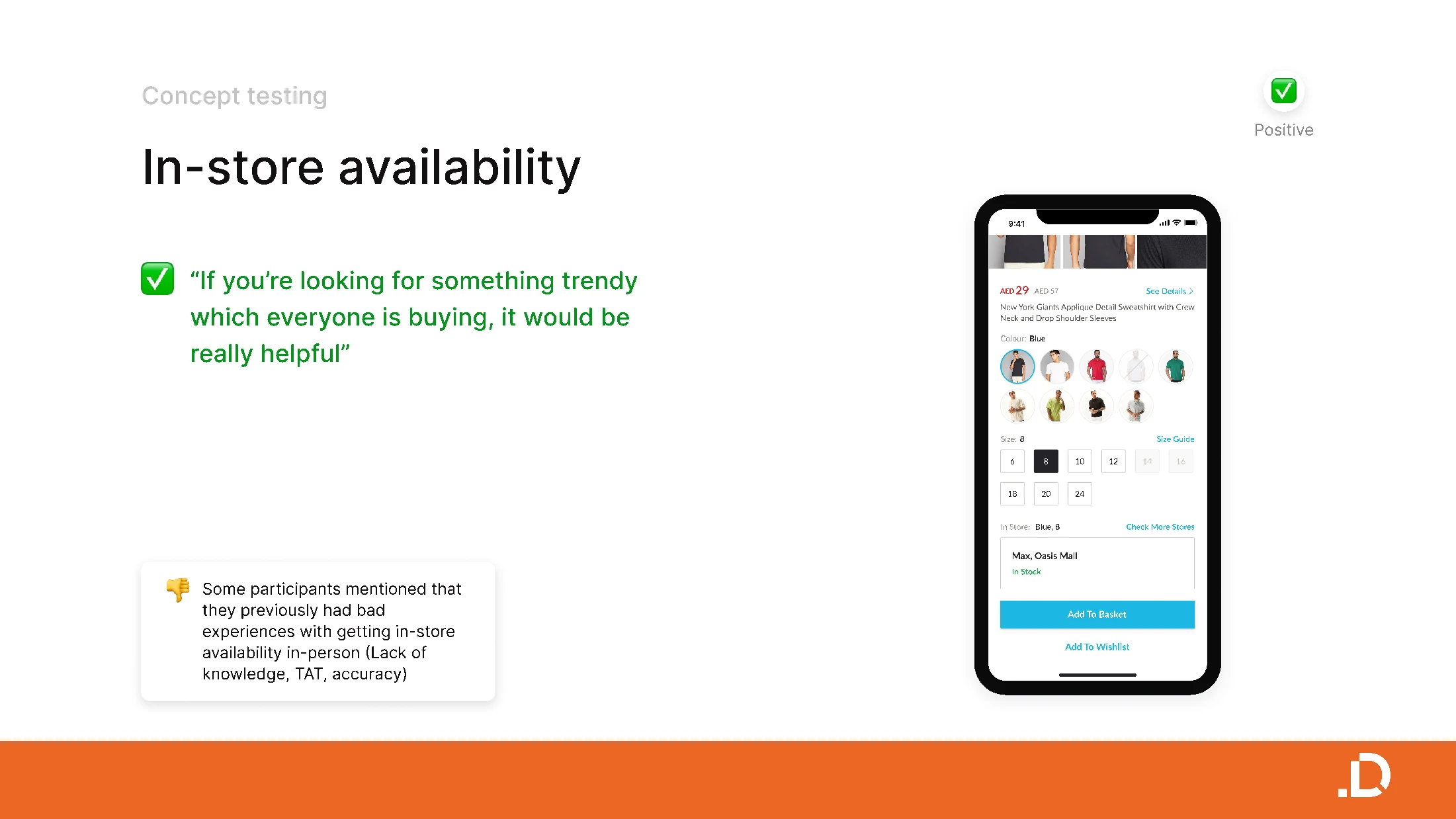
Shoppers can see which store has a specific item, size, or colour before they visit. Participants responded positively to this, and some had struggled to get timely, accurate availability information in person.
Depends on accurate stock information, because customers would be planning a trip around what the app shows.
Product barcode scanner
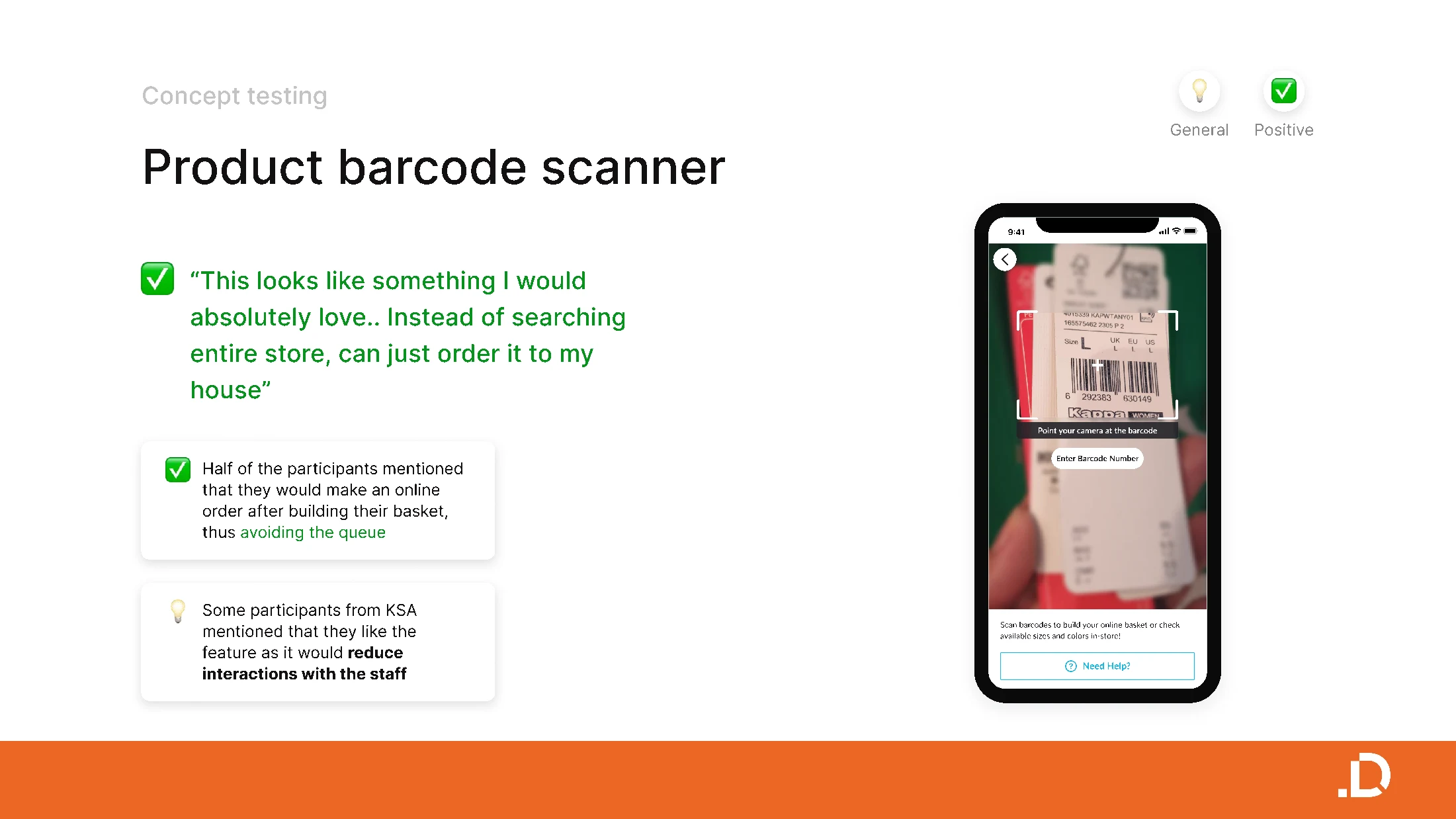
Scanning an item in-store lets shoppers check other sizes and colours, and build a basket to finish the purchase online. Half of the participants said they would order online this way to avoid the queue, and some participants in Saudi Arabia valued relying less on staff.
Depends on a convenient handoff once delivery or collection becomes part of the task. This remained an open question for the next round of testing.
Scan and go
Shoppers pay during their visit without waiting in a long queue. Most participants liked the idea or were open to using it, though their experiences with broken or unavailable self-service checkouts shaped their expectations.
Depends on a checkout that works reliably. Otherwise, a faster option becomes another source of frustration.
Digital receipts
Purchase information stays in the app, so shoppers don’t need to hold on to paper receipts. Interest varied: some participants only kept receipts for larger purchases, while others raised concerns about connectivity and price accuracy.
Depends on customers trusting the purchase information, and being able to access it when they need it.
Outcomes and reflection
The project produced two journey maps and feedback on four concepts. It gave us an initial view of what participants valued, and of what could get in the way of adoption. The next step would be to test these experiences in real shopping situations, to see whether they reduce uncertainty and waiting in practice.
For me, stock availability and product scanning were the clearest opportunities to explore further. Both supported behaviours we had heard about: finding the right store before travelling, and using online services alongside an in-person purchase.
Reliability turned out to be part of the design. A clear stock screen is only useful if the item is there when the customer arrives, and a faster checkout only helps if it works.